
Reinforcement Mesh Sizes: Rebar Mesh Size Chart
Standard Sheets 4.8 x 2.4m – Area: 11.52m2
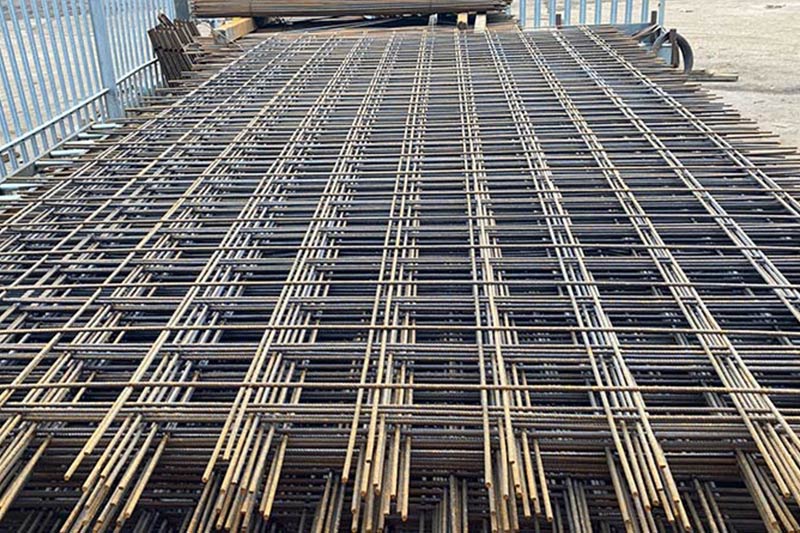
Steel reinforcing mesh sizes in the UK are defined by BS 4483 and commonly supplied in standard 4.8m × 2.4m sheets. The most common types are A393, A252, A193, and A142, which differ by bar diameter and spacing, affecting steel area and load capacity.
Longitudinal wires | Transverse / Cross wires | Mass | Weight | |||||
Mesh Type / British Standards Reference | Nominal Wire Size (mm) | Pitch (mm) | Cross Sectional Area per Metre Width (mm²/m) | Nominal Wire Size (mm) | Pitch (mm) | Cross Sectional Area per Metre Width (mm²/m) | Kg/m² | Kg/sheet |
A393 | 10 | 200 | 393 | 10 | 200 | 393 | 6.16 | 70.96 |
A252 | 8 | 200 | 252 | 8 | 200 | 252 | 3.95 | 45.5 |
A193 | 7 | 200 | 193 | 7 | 200 | 193 | 3.02 | 34.79 |
A142 | 6 | 200 | 142 | 6 | 200 | 142 | 2.22 | 25.57 |
A98 | 5 | 200 | 98 | 5 | 200 | 98 | 1.54 | 17.74 |
B1131 | 12 | 100 | 1131 | 8 | 200 | 252 | 10.9 | 125.57 |
B785 | 10 | 100 | 785 | 8 | 200 | 252 | 8.14 | 93.77 |
B503 | 8 | 100 | 503 | 8 | 200 | 252 | 5.93 | 68.31 |
B385 | 7 | 100 | 385 | 7 | 200 | 193 | 4.53 | 52.19 |
B283 | 6 | 100 | 283 | 7 | 200 | 193 | 3.73 | 42.97 |
B196 | 5 | 100 | 196 | 7 | 200 | 193 | 3.05 | 35.14 |
C785 | 10 | 100 | 785 | 6 | 400 | 70.8 | 6.72 | 77.41 |
C636 | 9 | 100 | 636 | 6 | 400 | 70.8 | 5.55 | 63.94 |
C503 | 8 | 100 | 503 | 6 | 400 | 49 | 4.51 | 51.96 |
C385 | 7 | 100 | 385 | 6 | 400 | 49 | 3.58 | 41.24 |
C283 | 6 | 100 | 283 | 6 | 400 | 49 | 2.78 | 32.03 |
D98 | 5 | 200 | 98 | 5 | 200 | 98 | 1.54 | 17.74 |
D49 | 2.5 | 100 | 49 | 2.5 | 100 | 49 | 0.77 | 8.87 |
Looking for Rebar Mesh?
We stock it. Along with Loose Cut & Bent, Prefab Components, and Materials & Accessories.
The cross-sectional area per metre width (mm²/m) is the key value used in design. It represents the amount of steel provided in each direction and is what engineers compare against required reinforcement from calculations.
Quick Use Cases:
- A142 – light domestic slabs, paths
- A193 – patios, driveways (light vehicles)
- A252 – standard house slabs, ground beams
- A393 – heavy-duty slabs, industrial
How Steel Area Per Metre Width Is Calculated
One of the key values in a reinforcing mesh size chart is the steel area provided per metre width, shown in mm²/m. This tells you how much steel is present in one direction of the mesh and is one of the main values used in design.
The basic relationship is:
As = (πd² / 4) × (1000 / s)
Where:
- As = steel area per metre width (mm²/m)
- d = nominal wire diameter (mm)
- s = wire spacing or pitch (mm)
- 1000 = converts the spacing to a 1 metre width
Worked Example: A252 Mesh
A252 mesh uses 8mm wires at 200mm centres in both directions. Using the formula:
As = (π × 8² / 4) × (1000 / 200)
As = 50.27 × 5 = 251.35 mm²/m
Rounded to the nearest whole number, this gives 252 mm²/m, which is where the A252 designation comes from.
The same logic applies to other standard mesh types such as A193, A393 and A142. As wire diameter increases or spacing reduces, the steel area per metre width increases.
In practice, this means the mesh designation is more than just a product code. It is a quick reference to the amount of steel being provided.