
This article summarises typical minimum thickness values referenced in UK and European standards. Final element thickness must always be determined by structural design for the specific project.
The minimum thickness of concrete elements depends on several variables: the type of member (slab, beam, column), the geometry, the aggregate size, reinforcement arrangement, required concrete cover, and fire-resistance performance. In the UK, these rules are set out in Eurocode 2: Design of Concrete Structures (BS EN 1992-1-1:2004+A1:2014), which remains the main design standard in use. A second-generation update (EN 1992-1-1:2023) has been published, but widespread industry adoption is still in progress, so the existing guidance remains the basis for most UK designs.
Below is a clear, practical summary of the Eurocode principles, along with typical real-world examples for residential and light-duty applications.
Quick Links:
Minimum Thickness Of Concrete Slabs
A slab is defined as a member where the panel dimension is not less than 5 times the overall slab thickness. Eurocode 2 states minimum thickness for floor slabs in buildings is 125mm. Other countries may use different minimums depending on their national standards.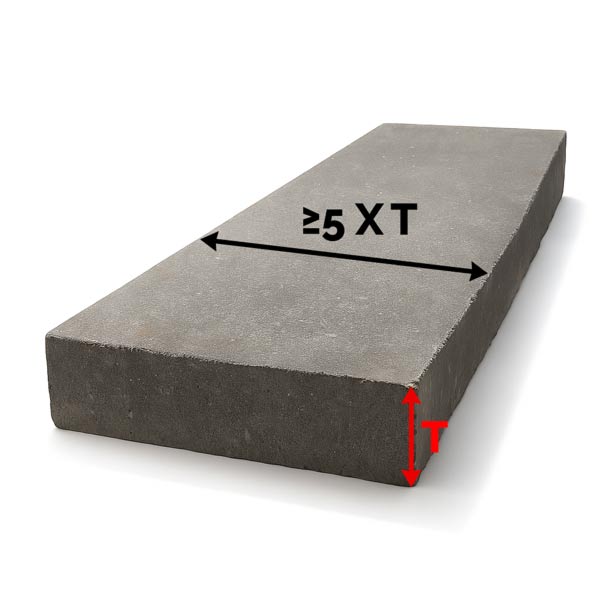
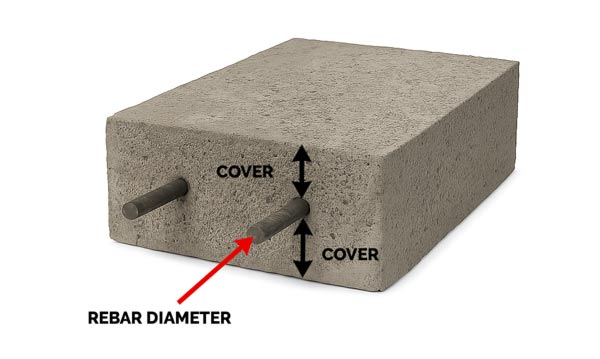
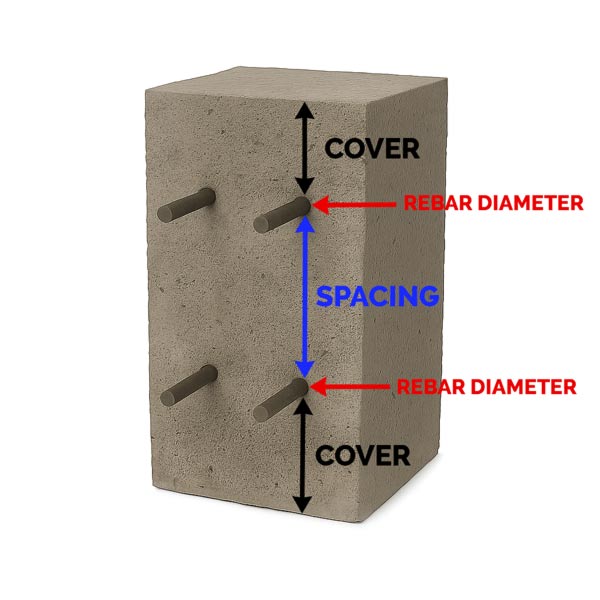
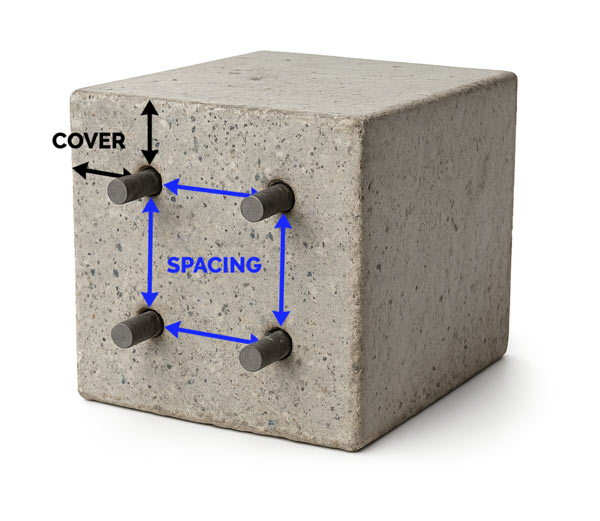
However, if there is any reinforcement included within the slab, this thickness will increase to ensure there is adequate concrete cover to the reinforcement (see the Reinforcement section for how this is calculated). If you have more than one row of reinforcement, you’ll need to include the spacing between the bars in your calculation of the minimum thickness as well – see the diagram below.
Eurocode 2 links cover requirements to environmental exposure classes such as:
- XC1: dry internal conditions
- XC2: wet, rarely dry
- XC3: moderate humidity
- XC4 / XD / XS: higher risk of carbonation, chlorides, or aggressive conditions
Higher exposure classes may require increased cover, which in turn increases minimum slab thickness. For instance, a slab in a marine environment might need to be considerably thicker than the same slab in an internal, dry environment, simply to accommodate the increased cover requirements.
Looking for a Great Quote for Steel Reinforcement?
Concrete Strength
The strength of your concrete will also affect the minimum thickness. Stronger grades of concrete can provide thinner slabs – up to a point. This is because they will be able to resist the loads on them better than weaker grades of concrete. However, stronger grades of concrete generally require a higher amount of reinforcement for cracking control, which may result in uneconomical solutions.
Support Conditions
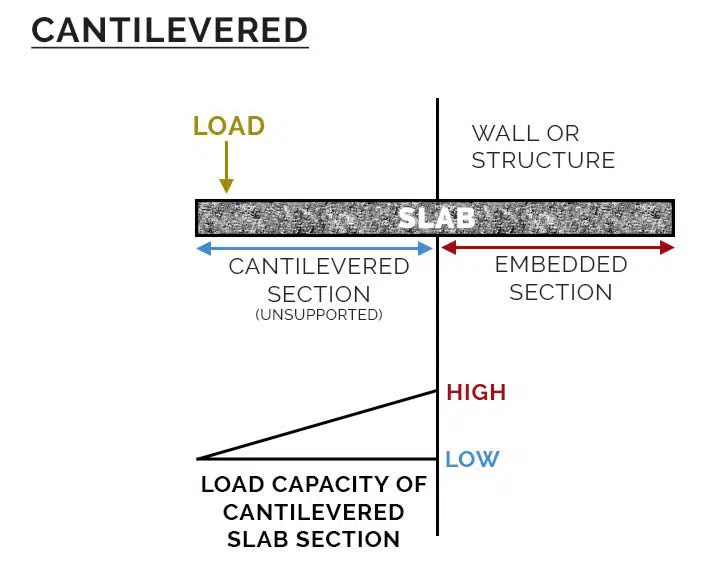
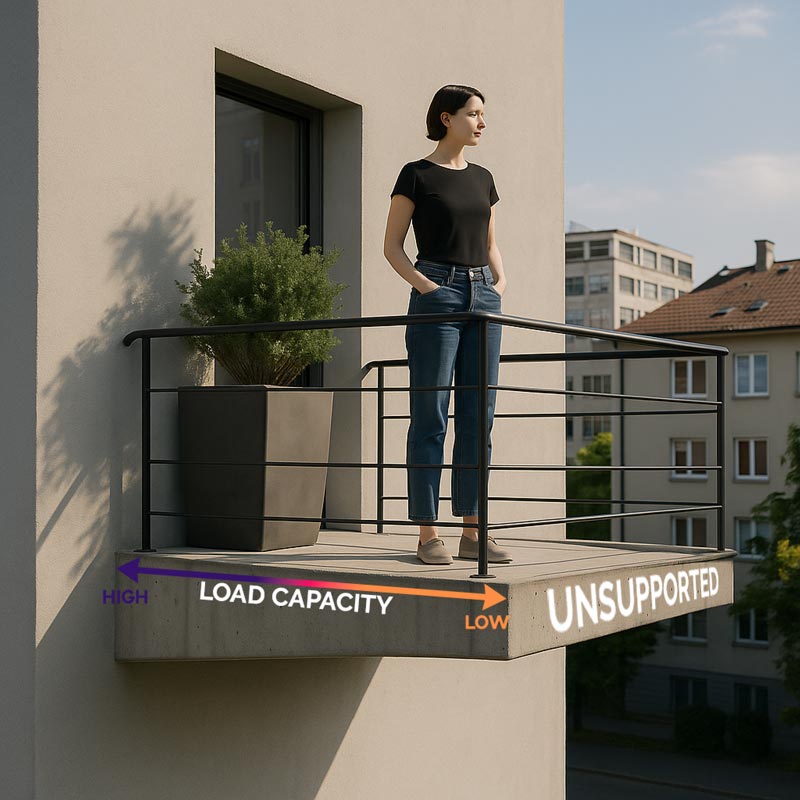
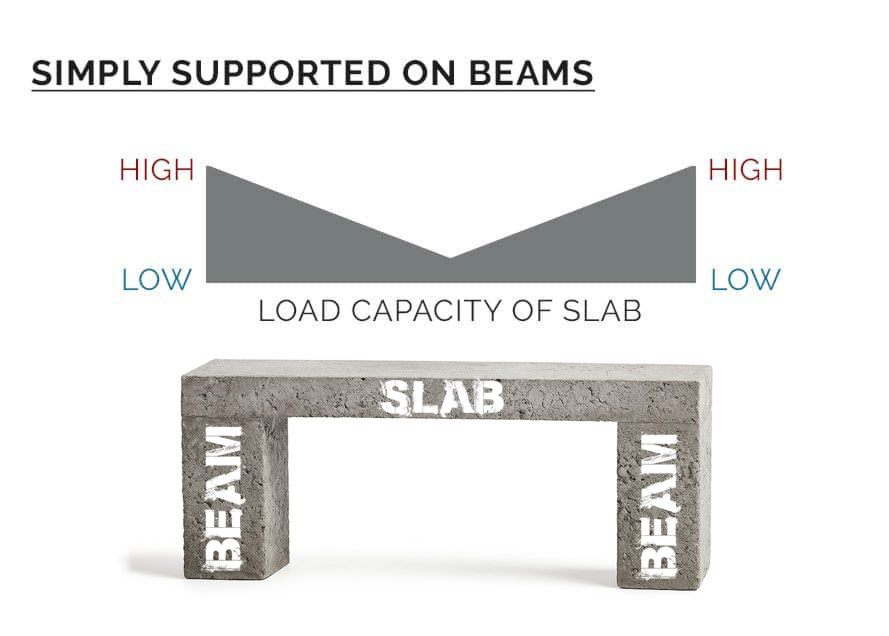
Another factor in the minimum thickness of slabs is how the slab will be supported – i.e. is it a slab cast directly onto the ground, simply supported on beams or columns, continuously supported on one or both ends, or cantilevered. These support conditions affect the load-bearing capacity of the concrete. For example, if your concrete slab is cantilevered and is too thin, a heavy load applied to the unsupported end will break the cantilevered section. This is because the load-bearing capacity of the slab reduces the further away from the supported section it is. On a simply supported slab, the load-bearing capacity of the slab is lowest in the middle. See the diagrams below for how these two support conditions differ.
Minimum slab thickness is not only controlled by strength. Serviceability (deflection and cracking) often governs slab design, especially for longer spans. Even if a thinner slab is technically strong enough, Eurocode 2 may require increased depth to meet deflection limits, so that the comfort of users is always respected.
Typical Situations
While there are many variables in the minimum thickness of slabs, there are some standard thicknesses used for typical situations. It’s important to remember that these may not be appropriate for your loading conditions, however. See Table 7.4N in Eurocode 2 for more information.
N.B. Situations such as footpaths, patios and small domestic slabs are generally not designed using Eurocode 2 and instead follow practical construction norms. These examples are included to show typical real-world values, but actual loading, ground conditions and reinforcement may require different thicknesses. For simplicity and safety, a minimum of 125 mm is a sensible baseline for most small domestic slabs.
| Use | Thickness (mm) | Thickness (in.) |
|---|---|---|
| Footpaths | 75mm | 3” |
| Patios (foot traffic only) | 100mm | 4” |
| Driveways and parking areas | 150mm | 6” |
| Ground-bearing concrete floor slabs (residential construction) | 100mm | 4” |
| Simply supported slab, one- or two-way spanning | Length/20 (lightly stressed) Length/14 (highly stressed) | |
| One-way continuous slab | Length/26 x 1.3 (lightly stressed) Length/18 x 1.3 (highly stressed) | |
| Slab supported on columns without beams (flat slab) | Length/24 x 1.2 (lightly stressed) Length/17 x 1.2 (highly stressed) | |
| Cantilevered slab | Length/8 x 0.4 (lightly stressed) Length/6 x 0.4 (highly stressed) | |
Minimum Thickness of Concrete Beams
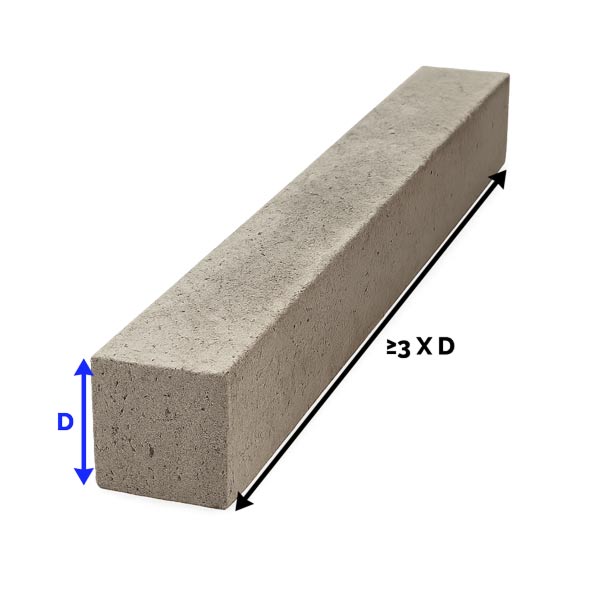
A beam is defined as having a span not less than 3 times the overall section depth. Otherwise it is considered a deep beam. Beams are typically the horizontal concrete members. They can have a square or rectangular cross-section, where the thickness refers to the same dimension as the height or depth.
Beams are similar to slabs in terms of minimum thicknesses, in that Eurocode 2 uses a length to depth (or slenderness) ratio to determine the depth of the beam as per the following table. However, this applies only to beams with a rectangular cross-section,with two different reinforcement ratios (1.5%, where concrete is highly stressed, and 0.5%, where concrete is lightly stressed) and are fairly conservative. Respecting the slenderness values of the table means that no further control of the deflections by calculation is needed. In practice, having a structural engineer calculate the required beam thickness may well result in a thinner beam than using this table.
Second-Generation Eurocode Context
The second-generation Eurocode introduces updated span-to-depth rules and refinements for shear, minimum compression zones and redistribution. However, the ratios in this article remain representative of UK practice in 2025 and are still used in most designs.
Use | Thickness (mm) |
|---|---|
| Simply supported beam | Length/20 (lightly stressed) Length/14 (highly stressed) |
| End span of continuous beam | Length/26 x 1.3 (lightly stressed) Length/18 x 1.3 (highly stressed) |
| Interior span of beam | Length/30 x 1.5 (lightly stressed) Length/20 x 1.5 (highly stressed) |
| Cantilevered beam | Length/8 x 0.4 (lightly stressed) Length/6 x 0.4 (highly stressed) |
Minimum Thickness of Concrete Columns
A column is defined as having a section depth no more than 4 times its width, and the height is a minimum of 3 times the section depth. Concrete columns tend to be specified as a minimum cross-sectional size (i.e. 225mm x 225mm is the minimum size) rather than a minimum depth, as they are vertical elements. However, column dimensions are based on the design requirements, loading, and column shape (circular, rectangular, square, polygonal) so it’s not possible to use a minimum size for these members.
Current practice in UK residential work still commonly uses minimum practical dimensions such as 225 × 225 mm. However, designers now increasingly consider slenderness, second-order effects and buckling in line with the updated Eurocode provisions, which may result in larger section sizes depending on loading and height.

Minimum Thickness Reinforcement Bond and Protection
Reinforcement within concrete requires an adequate amount of concrete to be laid over it (called cover) to ensure the reinforcement transmits the stresses to the surrounding concrete through a good bond behaviour, while also protecting it from corrosion and providing adequate fire resistance. Cover is the distance between the surface of the reinforcement closest to the surface of the concrete and the surface of the concrete, whereas the distance between the bars is the spacing.
Additional Note – Exposure Class & Durability
Minimum cover depends on the exposure class (XC, XD, XS, XF etc.), required design life, and the quality control level during construction. For example:
- XC1 (dry internal): typically lower cover
- XC3 (moderate humidity): moderate cover
- External aggressive conditions: increased cover
These values directly influence minimum thickness because additional cover increases the total depth required.
Additional Note – Fire Resistance
Eurocode 2 links cover thickness to fire-resistance periods (R30, R60, R90, R120). Longer fire ratings generally require thicker cover, which increases the required minimum depth of the concrete element.
The density, quality and thickness of cover to reinforcement as well as the extent of cracking will all affect the corrosion protection and fire resistance of the concrete.
How to Calculate Cover Minimum Thickness
What we would normally think of as the cover “minimum thickness” is actually called the cover nominal thickness and is indicated on structural drawings. It is calculated by determining the minimum thickness plus a tolerance for any deviations.
Cnom = Cmin + ∆Cdev
Typically, the absolute minimum that this value will be is 20mm, which is made up of 10mm of minimum cover and 10mm of allowance for deviation. However, this can vary depending on the situation – if you are casting concrete directly onto the ground or using prestressed tendons, for example, then the cover will likely be increased.
The Minimum Cover Cmin
The minimum amount of cover (Cmin) is determined by comparing the minimum cover required to achieve an adequate bond between the concrete and reinforcement, that is the transmission of bond forces from the reinforcing bars to the concrete and the minimum cover required for the environmental conditions (such as if the reinforcement is a prestressed tendon, the desired design working life, quality control of the concrete, etc.). The highest value of these two values is used, unless they are both less than 10mm, in which case 10mm is the minimum. And if there is an uneven surface that the concrete is being cast onto, such as exposed aggregate, the minimum cover should be increased by at least 5mm for a total of 15mm minimum cover. Similarly, if large aggregates are used in the concrete mix (32mm or greater nominal aggregate size) then the cover will also need to be increased by 5mm to allow for this.
The Cover Allowance ∆Cdev
Added to the minimum cover is an allowance for any deviation when the concrete is installed (∆cdev), much like a tolerance. This allows for any low spots in the concrete as it cures. The recommended value of cover allowance is 10mm according to Eurocode 2. However, in some situations, this value can be reduced or increased where the accepted deviation will be more or less than 10mm.
Reducing Cover Allowance
A good example for when the cover allowance would be reduced would be when precast concrete elements are being used, as the factory will typically have a higher standard of quality control n a construction site. In this case, the finished surface of the concrete might be accurate to within a few millimetres, so the cover allowance may be reduced to anywhere between 0-10mm. Similarly, if there is a rigorous quality management system in place that monitors the cover depth during fabrication, the cover allowance can be reduced to between 5-10mm.
Increasing Cover Allowance
On the other hand, if concrete is being cast against an uneven surface – such as onto the existing ground for example – the cover allowance needs to be increased to allow for greater differences in the surface. The recommended values in this instance are:
- For concrete cast against prepared ground, including blinding: 40mm
- For concrete cast directly against soil: 75mm
Other reasons why you might increase cover include the finish that needs to be achieved, such as ribbed finishes or leaving aggregates exposed.
Typical Minimum Cover Thicknesses
For concrete that isn’t designed by an engineer, the minimum cover for typical residential situations is given in the NHBC Standards. The current NHBC Standards (2024 edition) use these practical minimum cover values for typical residential construction::
Concrete Position | Minimum Cover (mm) |
|---|---|
| In contact with the ground | 75 |
| External conditions | 50 |
| Cast against a DPM on sand blinding | 40 |
| Against adequate blinding concrete | 40 |
| Protected or internal conditions | 25 |
Summary
While Eurocode 2 provides clear rules for minimum thickness, the final dimensions of any concrete element depend on span, loading, reinforcement layout, cover requirements, exposure conditions and fire-resistance performance. For domestic slabs and light-duty applications, practical thicknesses between 100–150 mm are common; however, engineered structures may require more precise calculations.
For reinforcement, prefabricated components, or help interpreting thickness requirements, you can view our reinforcement products or request a custom quote.
FAQs
What is the minimum thickness of a concrete slab under Eurocode 2?
Eurocode 2 gives a minimum slab thickness of 125 mm for most building-floor applications. Actual required thickness may be higher depending on span, support conditions, reinforcement, cover, and fire resistance.
Does adding reinforcement increase the required concrete thickness?
Yes. Reinforcement requires concrete cover, which adds to the minimum depth. If the slab has multiple layers of steel, the spacing between bars also increases the required thickness.
What factors affect the minimum thickness of a concrete slab?
Key factors include span, loading, support type (simply supported, continuous, or cantilevered), reinforcement layout, required cover, concrete strength, exposure class, and fire-resistance rating.
What is the typical thickness for domestic slabs such as patios and driveways?
Common practical values are:
• Footpaths: 75 mm
• Patios (foot traffic only): 100 mm
• Driveways and parking areas: 150 mm
A safe baseline for most domestic slabs is 125 mm, unless design conditions require more.
How thick should a concrete beam be?
Eurocode 2 uses span-to-depth ratios without further check of the defections. Typical values include:
• Simply supported beams: L/20 to L/14
• Continuous beams: L/26 × 1.3 to L/18 × 1.3
• Cantilevers: L/8 × 0.4 to L/6 × 0.4
Is there a minimum size for concrete columns?
Columns are usually defined by minimum cross-section rather than depth. In UK residential settings, 225 × 225 mm is often used, but actual size depends on load, slenderness and column height.
What is concrete cover, and why is it important?
Concrete cover is the distance between reinforcement and the concrete surface. It provides bond strength, corrosion protection, and fire resistance. Required cover varies with exposure class and construction tolerances. Higher concrete cover is associated with more durable structures, which means structures that are capable of withstanding actions from dead/live/wind loads over an increased duration (termed as design working life).
How is nominal cover (Cnom) calculated in Eurocode 2?
Nominal cover is calculated as:
Cnom = Cmin + ΔCdev
Where:
• Cmin = minimum cover (bond + durability requirements)
• ΔCdev = allowance for deviation (typically 10 mm)
What are the typical minimum cover values for residential concrete?
NHBC Standards (2024 edition) specify:
• In contact with the ground: 75 mm
• External exposure: 50 mm
• Cast against a DPM or blinding: 40 mm
• Internal or protected conditions: 25 mm
Does concrete strength affect minimum thickness?
Yes. Higher-strength concrete can allow thinner slabs in some cases, but slabs are often governed by deflection limits rather than strength, so thickness may still need to be increased. However, it should be noted that stronger concrete grades typically require a higher amount of reinforcement for cracking control, which may result in uneconomical solutions.
How do support conditions affect slab thickness?
Support conditions significantly change slab depth requirements. Cantilevers need thicker sections near the free end, continuous slabs may be thinner than simply supported slabs, and longer spans generally require deeper sections.
Is Eurocode 2 still valid in 2025?
Yes. The original Eurocode 2 (BS EN 1992-1-1:2004+A1:2014) remains the primary design standard in the UK. A second-generation update (EN 1992-1-1:2023) exists, but full adoption is still in progress.